
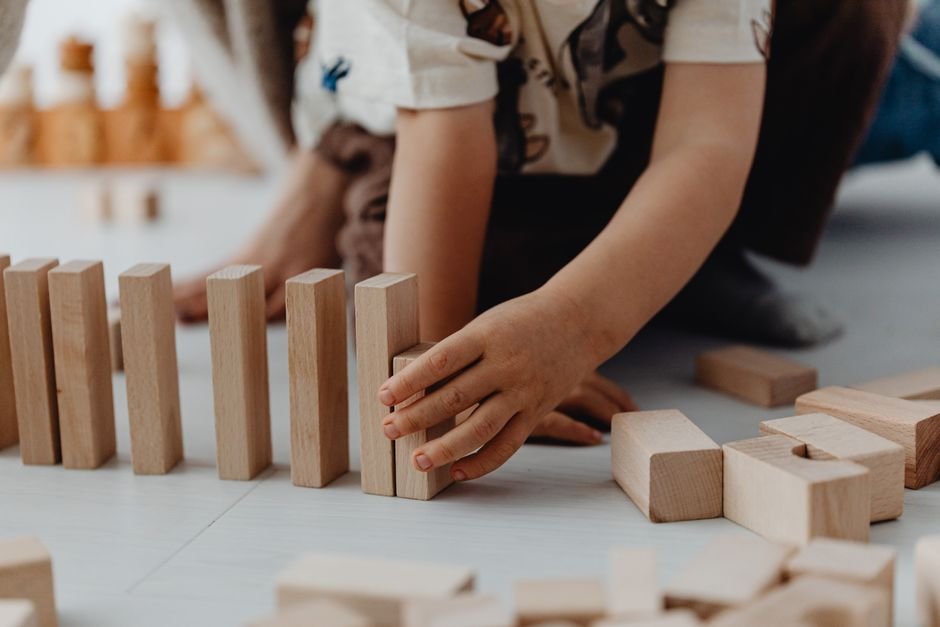
When parents hear that a preschool is “play-based,” some quietly worry their child isn’t really learning. It’s a completely understandable fear — most of us grew up believing that learning meant sitting still, staying quiet and filling in the page. But decades of research point firmly the other way: in the early years, play is how children learn, and it is backed by some of the strongest evidence in all of education. Let’s unpack what that really means, and how you can use it at home.
The myth, and the truth
The myth is that play and learning are opposites — that every hour of play is an hour “lost” from academics. The truth is that for a three- or four-year-old, play is the academics. It is how they build language, test ideas, practise patience and make sense of a big, confusing world. A child deep in play is a child deep in learning; you simply can’t always see the worksheet.
Free play + a warm, thoughtful teacher = powerful learning. It looks like fun because it is fun — and that is precisely why it works.
What the studies actually find
Reviews of the research, including a recent scoping review in the Early Childhood Education Journal, show that well-designed play grows the very abilities children need to thrive in school and in life — and often more effectively than early formal instruction:
Controlled studies make it concrete. Block play has been shown to improve mathematics and executive function. A randomised trial of a “playful learning” curriculum in Norway produced significant gains in maths. This is not wishful thinking — it is learning, measured carefully by researchers who set out to test it.
Why play works so well
Play fits the way a young brain is built to learn. Little children are wired to explore, imitate and repeat. When learning is wrapped in something joyful and meaningful, they stay engaged far longer, take healthy risks, and remember far more than they would from being told. Play is also where children first rehearse life: sharing, waiting, losing, trying again, standing in someone else’s shoes. Those rehearsals quietly build the focus, self-control and resilience that predict success long after preschool ends.
How guided play becomes learning
The secret ingredient isn’t just any play — it is guided play: the gentle loop of a child exploring while a skilled teacher stretches their thinking at exactly the right moment. It looks effortless, but it is a real craft.
graph LR; A[Child plays freely] --> B[Teacher notices the moment]; B --> C{Asks a gentle question}; C --> D[Child stretches their thinking]; D --> E[A new skill takes root]; E --> A;
Notice that the loop begins and ends with the child. The adult never takes over the play — they simply nudge it forward. “What do you think will happen next?” “How could we make the bridge stronger?” “I wonder why that one floated?” Each question invites the child one step deeper.
Different play, different learning
Every kind of play does a quiet, specific job. There is no such thing as “just playing”:
| When your child is… | They’re secretly building… |
|---|---|
| Building with blocks | Maths, planning, problem-solving, patience |
| Playing pretend (“shop”, “doctor”) | Language, empathy, story-thinking, self-control |
| Drawing, painting, play-dough | Fine motor strength for writing, creativity |
| Running, climbing, dancing | Coordination, confidence, focus |
| Puzzles & sorting | Logic, memory, early number sense |
| Water & sand play | Early science, cause and effect, calm |
A word on “school readiness”
Many parents worry that play won’t prepare a child for “real” school. In fact, the opposite is true. A child who has played richly arrives at Grade 1 able to concentrate, cooperate, hold a pencil, express ideas and bounce back from mistakes. Those are the true foundations of literacy and numeracy. Rushing to formal academics too early can actually slow a child down — and, worse, teach them that learning is a chore.
Turning everyday moments into learning
You don’t need worksheets or apps — you need everyday moments and a little curiosity of your own:
- Build a tower together and count the blocks as they tumble.
- Cook together and talk about “more”, “less”, “full” and “empty”.
- Tell a story — then let your child change the ending.
- When they ask “why?”, resist giving the answer straight away. Wonder out loud with them.
- Offer open-ended toys (blocks, boxes, dolls, dress-up) more often than ones that do only one thing.
- Let them be a little bored sometimes — boredom is where imagination begins.
Follow the fun, and the learning follows too.
Play grows up with your child
Play isn’t one single thing — it matures as your child does, and each stage builds on the last. Knowing the journey helps you see the learning hidden inside it:
- Solitary play (babies & young toddlers) — exploring alone, mouthing, banging, dropping. This is how they learn how the world behaves.
- Side-by-side play (around 2–3) — playing next to another child, not quite together. A vital first step toward friendship.
- Shared play (around 3–4) — building, chasing and cooperating with others; the birthplace of sharing, turn-taking and negotiation.
- Make-believe play (around 4–5) — rich pretend worlds with roles and rules. This is where language, empathy and self-control blossom most.
None of these stages is “better” than another — each is exactly right for its moment. A three-year-old happily playing beside a friend isn’t being anti-social; they’re doing precisely the developmental work their age calls for.
When to step in, and when to step back
One of the hardest parts of guided play is knowing when not to help. It’s tempting to solve the puzzle, settle the squabble or show the “right” way to build the tower. But children learn most when they wrestle with a problem themselves. The skill is to hover warmly — ready to help, but slow to take over.
Step back when your child is absorbed, trying and coping — even if they’re a little frustrated. Step in when frustration tips into distress, or when a gentle question could open a whole new door.
The magic phrase is a question, not an answer: “Hmm, I wonder what would happen if…?” “What could we try next?” “How did you do that?” Each one hands the thinking back to your child and tells them something powerful — that you believe they can figure it out. Over hundreds of these small moments, a child builds not just skills but confidence: the deep, quiet belief that they are a capable learner. That belief may be the most valuable thing play ever gives them.

 Ask Amma
Leave a Reply