Every parent stands at the same crossroads: which preschool is right for my child? The brochures all promise the world, the walls are always brightly painted, and every website says “holistic.” But strip away the marketing, and one question remains: what actually makes early education work? To answer it honestly, our founders Dr Pranay Jha and Amrita Jha studied and compared early childhood education across eight of the world’s most respected systems, in peer-reviewed research published in the Journal of Early Childhood Research (SAGE, 2025). This article shares what they found — and what it means for your family.
Eight countries, one surprising agreement
Finland, Singapore, Japan, Germany, the USA, the UK, Canada and Australia — eight countries, eight cultures, eight very different school systems. You might reasonably expect eight different answers about how young children should learn. Instead, one idea runs through all of them like a golden thread: in the early years, children learn best through play, exploration and warm relationships — not drills, worksheets or pressure.
That agreement is remarkable precisely because these countries agree on so little else. Their languages, budgets, class sizes and cultures differ enormously. Yet when it comes to three- and four-year-olds, the science points them all in the same direction.
graph LR; A[Finland] --> P; B[Singapore] --> P; C[Japan] --> P; D[Germany] --> P; E[USA / UK / Canada / Australia] --> P; P((Play-based, child-centred learning)) --> R[Confident, curious, capable children];
The methods differ — but the principle does not. Here is a quick tour, and the lesson each system offers us:
| Country | What they’re known for | The lesson for us |
|---|---|---|
| Finland | Delays formal academics; learning through play and the outdoors | Later isn’t slower — it’s deeper |
| Singapore | Blends gentle structure with playful, purposeful learning | Structure and play can live together |
| Japan | Focus on social skills, independence and belonging | Character matters as much as content |
| Germany | Nature and free play (the word “kindergarten” began here) | The outdoors is a classroom |
| USA / UK / Canada / Australia | Child-led inquiry, rich language, strong parent partnership | Follow the child’s curiosity |
Children everywhere learn best not by being drilled, but by exploring, questioning and doing — with a caring, skilled adult alongside them. Play is not a break from learning. Play is the method.
What “play-based” really looks like
“Play-based” is one of the most misunderstood phrases in education. It does not mean children run wild while teachers watch from the side. In the best classrooms it looks calm, purposeful and quietly busy. A child stacking blocks is doing early physics and mathematics — testing balance, comparing sizes, predicting what will fall. Two children running a pretend shop are practising language, negotiation, turn-taking and number. A teacher kneels beside them and asks, “I wonder what would happen if we made the tower taller?” — and in that single question, the learning deepens.
That blend of freedom to explore and gentle, intentional guidance is the quiet engine behind every world-class system. Remove the freedom and you get anxious, passive children. Remove the guidance and you get busy-ness without growth. The magic is in the balance.
Why does play work so well?
Because it fits how a young brain is built to learn. Little children are wired to explore, imitate and repeat. When learning is wrapped in something joyful and meaningful, they stay engaged far longer, take healthy risks, and remember more. Play also builds the “hidden curriculum” that predicts later success — focus, self-control, resilience, and the confidence to try, fail and try again. These are not soft extras; they are the foundation everything else is built on.
The honest picture in India
The research does not look away from the hurdles closer to home. Naming them clearly is the first step to doing better:
- Awareness. Many families have never been shown why play-based learning works — so early academics can feel “safer” and more reassuring.
- The pressure to accelerate. A strong cultural pull toward early reading, writing and rote can rush children past the very foundations they need to read and write well later.
- Teacher support. Great early educators need proper training and mentoring — which is still uneven across the country.
- Access. Quality spaces, materials and small class sizes remain out of reach for many migrant and rural families.
None of these are reasons for despair. They are simply the work in front of us — and every one of them can be improved with awareness, training and care.
What good looks like — through a parent’s eyes
You do not need a research degree to spot a good preschool. On a visit, watch for the same signals the world’s best systems share:
- Children who look absorbed and happy, not bored or anxious.
- Teachers down at eye level, talking with children rather than at them.
- Real play — blocks, art, water, sand, pretend — not rows of desks and worksheets.
- Small groups where every child is genuinely noticed.
- A calm, kind, unhurried atmosphere.
What this means at Neevalay
We built Neevalay Tots to bring these global best practices to Indian homes and classrooms — play-based and holistic, but rooted in our own languages, values and context, and fully aligned with India’s National Education Policy 2020. The goal is not to copy Finland or Singapore. It is to take what the evidence shows works everywhere, and shape it thoughtfully for children growing up here.
World-class early learning shouldn’t be a luxury. It should be thoughtful, joyful, and built for the children right in front of us.
If there is one thing to carry away, let it be this: trust play. The best educators on earth do — and so can you, at home, today.
What this looks like in a real classroom
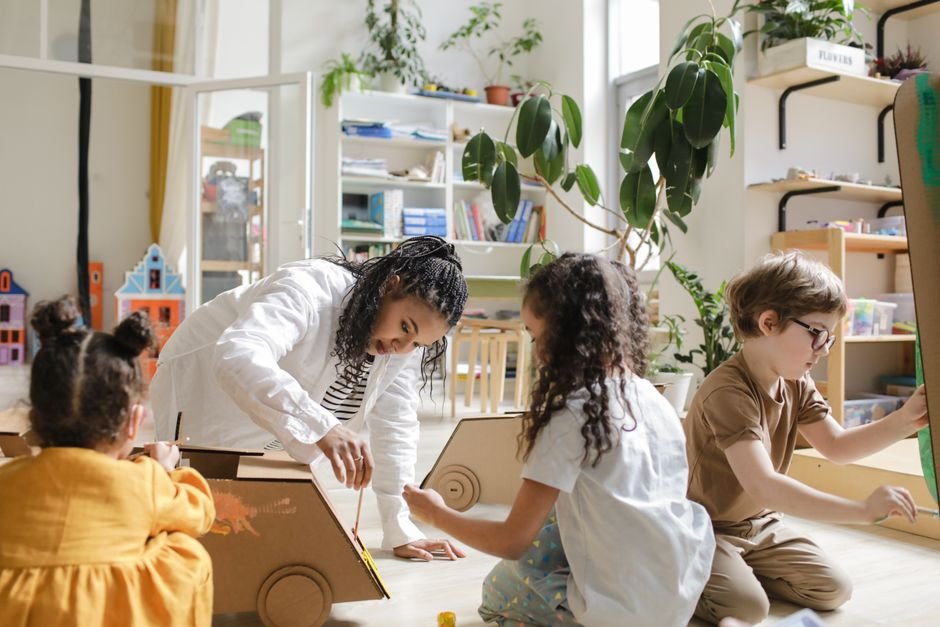
It’s one thing to say “play-based” and another to see it. In a genuinely world-class early classroom, the room itself does much of the teaching. Instead of rows of desks facing a board, you find inviting corners — a home area for pretend cooking, a block corner humming with tiny engineers, a book nook with cushions, a messy table for sand and water, an art shelf stocked with real materials. Children move between these freely, following their curiosity, while teachers watch closely and step in at just the right moments.
A typical morning might flow like this: children arrive to a warm welcome and settle with a song; they choose their own play for a long, unhurried stretch; a teacher gathers a small group to read a story and wonder aloud about it; everyone heads outside to run, climb and dig; then they come together to share what they made and felt. There is structure — but it is gentle, predictable and built around the child, not the clock. Crucially, there is time: deep play needs long, uninterrupted stretches, not a timetable chopped into ten-minute lessons.
The best sign of a great preschool isn’t a wall of certificates — it’s the sound of the room. Busy, happy chatter and absorbed, focused faces mean real learning is happening.
Bringing the world’s best home
The wonderful truth is that the ingredients that make Finland’s and Singapore’s preschools great cost almost nothing — and you can offer them at home. You don’t need expensive toys or elaborate lessons. You need warmth, time, conversation and the freedom for your child to explore. Read together every day. Let them help you cook and count and pour. Answer their endless “why?” questions with curiosity rather than a rushed reply. Let them get muddy, build dens, and be a little bored so imagination can fill the gap.
When you choose a preschool, look past the marble floors and marketing and ask the simple questions the science points to: Do the children look happy? Do the teachers get down to their level? Is there real play, every day? Those quiet signals — not the brochure — are what the world’s best preschools truly have in common. Choose warmth and play, and you give your child the same strong start as children in the highest-performing systems on earth.
 Ask Amma
Leave a Reply